Chapter 1
Every year, I organize a company trip over Founders' Week.
We've gone everywhere from the Silverpine Range to the Northreach, from the Coral Keys to the Wildgrass Plains. Sign-up is voluntary, and the trip costs an average of over $750 per person.
Anyone who doesn't go gets an extra $150 holiday stipend from the company.
But then a new intern posted online that I was hijacking everyone's time off for pointless team building just to feed my own vanity.
I posted one line in the company group chat:
"Since the trip is pointless, starting this year, all extra perks are canceled."
The next day, he confronted me in the chat:
"Fine, we can skip the trip. But why is the $150 gone too?"
I looked at the screen and laughed.
You can't keep only the most valuable piece of a benefit package and toss the rest.
Chapter 1
Every year before Founders' Week, the biggest buzz around the office wasn't the holiday announcement.
It was the travel sign-up.
We weren't a big company, just over eighty employees.
Starting in my second year as founder, whenever the business could afford it, I set aside a budget for one employee trip a year.
The first year, we went to the canyon terraces at Copper Mesa.
The second, we did the High Basin desert loop.
After that came the Coral Keys, the Ashwood Highlands, the Silverpine Range, and the Wildgrass Plains.
The destination changed every year, but the standard never did.
Transportation, hotels, admission tickets, meals, and travel insurance were all paid by the company.
Employees could bring family members, but family expenses were their own.
The most important rule was that participation was completely voluntary.
Anyone who didn't sign up didn't have to explain why.
It had no effect on attendance, performance reviews, making it past probation, or promotion.
We also gave anyone who skipped the trip a $150 holiday stipend.
The stipend had originally been our finance manager's idea.
She'd pointed out that some employees wanted to go home for the holiday.
Some had elderly parents to care for.
One group trip was never going to suit everyone.
I agreed, so I wrote the cash alternative directly into the annual benefit plan.
For five years, nobody had ever been punished for staying home.
This year's destination was the Northreach route.
When the vendor quote came in, finance sent me the budget: about $780 per participating employee.
I signed off on it, and administration posted the registration link in the company group chat.
The chat immediately came alive.
"I'm in. I want to see Kestrel Lake."
"Can we fit in one horseback-riding day?"
"I want to bring my parents. I'll pay their share."
Paula Finch, our administration manager, had run the trip for five years.
She reminded everyone:
"Registration closes Friday at 6:00 p.m. Participation is voluntary. If you're not joining, choose the $150 holiday stipend in the form. Stipends will be paid before the break."
I had just finished reading her message when the conference-room door opened.
Trent Barlow stood there.
He had been with us less than a month.
He was a social-media intern assigned to our short-form video accounts.
Instead of sitting down, he asked:
"Mr. Kessler, does the company do this every year?"
"If business conditions allow it, yes."
"Why does it have to be Founders' Week?"
"Because people are already off and the itinerary is easier to plan."
Trent frowned.
"Founders' Week is employees' own time."
"That's why the trip is voluntary."
He ignored that answer and raised his voice.
"People always say it's voluntary. Who knows whether the boss remembers who doesn't go?"
The room went quiet.
Several employees who were filling out the form looked up.
I met his eyes.
"Do you have any evidence of that?"
He hesitated for half a second.
"Workplace pressure doesn't always leave evidence."
"If you don't have evidence, don't pass off a guess as a fact."
He stared at me, clearly surprised I had answered that directly.
Then he gave a short laugh.
"I'm only reminding people to protect their rights."
"They don't need reminding. The policy's right there on the screen."
I pointed toward the registration page.
"If you want to go, sign up. If you don't, take the stipend."
Trent glanced at the form and walked out.
I assumed that was the end of it.
The next morning, Paula sent me a screenshot.
The headline read:
BOSS FORCES EMPLOYEES TO SPEND THEIR HOLIDAY ON TEAM BUILDING JUST FOR SOCIAL MEDIA PHOTOS
The author was Trent Barlow.
I read the post once, then asked just one question.
"Did he sign up for the trip?"
Paula shook her head.
"No."
"Did he select the stipend?"
"No."
I opened the registration sheet.
Next to Trent's name, both boxes were blank.
Chapter 2
In under two hours, Trent's post was trending on the local job boards.
He wrote:
"Our boss organizes a company trip every Founders' Week and calls it an employee benefit. In reality, it's just so he can take photos, post them online, and feed his own vanity."
"Anyone who doesn't go gets remembered by management, and interns are too scared to say no."
"Founders' Week is supposed to be our time off, but the boss hijacks it for pointless team building."
He attached three photos.
The first was a group picture from last year's trip to the Wildgrass Plains.
The second showed me speaking in front of a tour bus.
The third was this year's promotional image for the Northreach route.
He didn't include the registration form.
He didn't include the $150 stipend language.
Worse, he labeled employees by name in the group photo.
Some were on vacation, some had brought family, and one had just been walking past when the photo was taken.
Trent described all of them as "employees forced to attend company team building."
The comments ignited immediately.
"Classic performative boss."
"Why not just give people the holiday off?"
"Intern has guts. Respect."
"Taking over people's time off and calling it a perk? Shameless."
Within thirty minutes, people had dug up our office address and the company's social media accounts.
The recruiting line rang nonstop.
Strangers messaged our front desk demanding a public apology.
Then messages started popping up in the company group chat.
"Is that post about us?"
"Trent, why did you put internal information online?"
Trent replied almost immediately.
"I'm just saying what everyone else is afraid to say."
A few people joined him.
"I don't really like long trips, but it feels awkward to refuse."
"Travel can be exhausting. I'd rather stay home."
"If the company really cares about people, just let us rest."
Then someone else wrote:
"You posted our names and sign-up information. Can you take that down first?"
Trent didn't answer.
Ten minutes later, he posted:
"Anyone who is afraid to be seen knows this whole thing is shameful."
I read the chat without replying.
Paula sat across from me, red-faced with anger.
"The policy clearly says there's a stipend. Why did he leave that out?"
"Because the stipend ruins his story. He isn't talking about a benefit. He's selling a story about a boss who exploits his employees."
"So do we put out a statement?" Paula asked.
I didn't answer right away.
First, I asked finance to pull five years of travel budgets, registration lists, stipend payments, and performance data.
An hour later, the files were on my desk.
Year one: forty-six employees traveled, twenty-seven didn't.
Year two: fifty-two traveled, thirty-one didn't.
Year three had the highest participation: sixty-seven.
Every year, employees who skipped the trip received the stipend.
Across five years, the company had spent more than $430,000 on travel and alternative stipends.
Then I asked IT to review Trent's access logs.
Around the time of his post, he had logged into the administration shared drive six times and downloaded budget files, registration lists, vendor quotes, even the employee emergency-contact sheet.
Paula's voice tightened.
"He downloaded emergency contacts?"
I nodded. "Shut off his access first."
"What about the post?"
"Have legal preserve it."
And Trent claimed I only organized the trips for the photos.
I turned to the final page of this year's benefit document.
One sentence appeared in bold.
EMPLOYEES MAY CHOOSE EITHER THE COMPANY HOLIDAY TRIP OR THE $150 ALTERNATIVE STIPEND. NEITHER CHOICE AFFECTS EMPLOYMENT STATUS OR WORKPLACE OPPORTUNITIES.
Trent's signature sat at the bottom.
The system also showed when he had acknowledged it: yesterday at 3:17 p.m.
He hadn't missed the rule. He'd seen it, then deliberately cropped it out.
I looked at the page for a moment and messaged HR.
"Preserve the signed original."
Paula looked up.
"Jordan, what are you going to do?"
I placed my phone on the table.
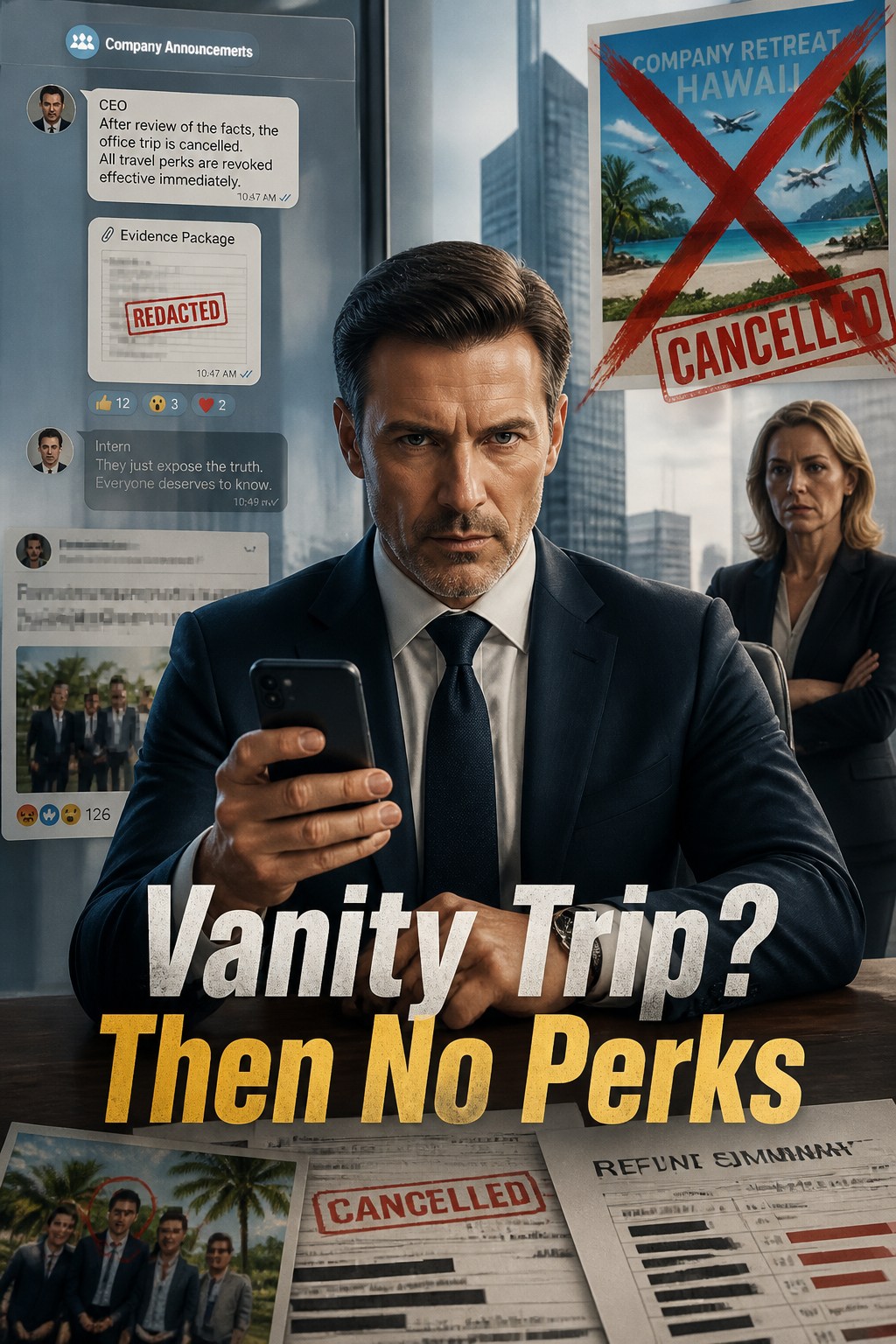
"If the trip is vanity, cancel it."
Her eyes widened.
"More than forty people already registered."
"Notify them."
I paused.
"Cancel the stipend too."
Her expression changed completely.
"The stipend too?"
"The trip and the stipend are one package."
Chapter 3
At three that afternoon, I opened the company group chat and drafted the notice.
It contained three decisions.
This year's Founders' Week trip was canceled.
The $150 alternative stipend tied to the trip was canceled.
All other discretionary holiday extras for the rest of the year were canceled as well. Only legally required leave and benefits promised by contract would continue.
Before I sent it, I had finance list every deposit, insurance payment, and transportation reservation already made.
Of the roughly $60,000 trip budget, about $27,000 was already locked in.
I told administration to stop all ticketing immediately and recover whatever could still be recovered under the contracts.
Refundable money would come back.
Nonrefundable money would be recorded as loss.
Paula stood beside me and asked quietly, "Are you really canceling the stipend too?"
"Yes."
"Won't people say it's retaliation?"
I opened the benefit policy to the final page.
"Retaliation is deliberately punishing someone when there are no rules to go by.
"We're just ending an extra perk that somebody publicly trashed."
I had HR review the wording line by line.
There was no "punishment."
No "discipline."
The notice said only that contractual compensation and required leave remained unchanged.
Legal compared the employment agreements against the annual benefit plan.
"Jordan, neither the trip nor the stipend is in the employment contracts, so canceling them is fine in itself. Just don't word it as if one employee's post caused this."
"I know."
"The notice will say the company is adjusting discretionary benefits. No names."
Administration then cataloged every hotel block, airline reservation, ground transfer, and insurance charge.
Each line included the refundable amount and the estimated loss.
"What are we looking at?" I asked.
"About $27,000 is already locked."
"We may recover roughly $16,500."
"So around $10,500 in cancellation loss?"
"Approximately."
"Record it."
"Against Trent?"
"Log it first. Don't draw conclusions yet."
I don't let emotions decide who's responsible.
I wanted a timeline that could survive scrutiny from anyone.
HR raised another question.
"What if employees made personal purchases because they expected the trip?"
"They can ask."
"What do we tell them?"
"The company is canceling a discretionary benefit. Contractual benefits are unchanged. Personal purchases remain personal choices."
It sounded heartless.
But rules are rules.
Then Trent messaged me privately.
"You should think carefully. If you publicly apologize now, you may still save your reputation."
A voice message followed.
"If this isn't resolved by eight tonight, I'm sending the full file to media outlets."
He mentioned several employees by name.
He was clearly trying to use coworkers' personal information as leverage.
I didn't respond.
Instead, I attached the pinned group announcement, the sign-up form, the stipend deion, and his signed acknowledgment to the notice.
Then I read the final notice one more time.
"Following review, and in light of recent concerns from some employees that the Founders' Week trip is pointless team building that takes up their personal time off, the company has decided to cancel this year's trip."
"The related $150 nonparticipation stipend, family spots, company transportation, and post-holiday flex days are canceled along with it."
"Effective immediately, all remaining extra holiday perks for this year are also canceled, including gift boxes, holiday bonuses, and other one-off perks."
"The company will maintain only legally required holidays and the compensation and benefits set out in employment agreements."
Then I added one final sentence.
"Enjoy a holiday that's truly your own."
I pressed Send.

 GoodNovel
Completed